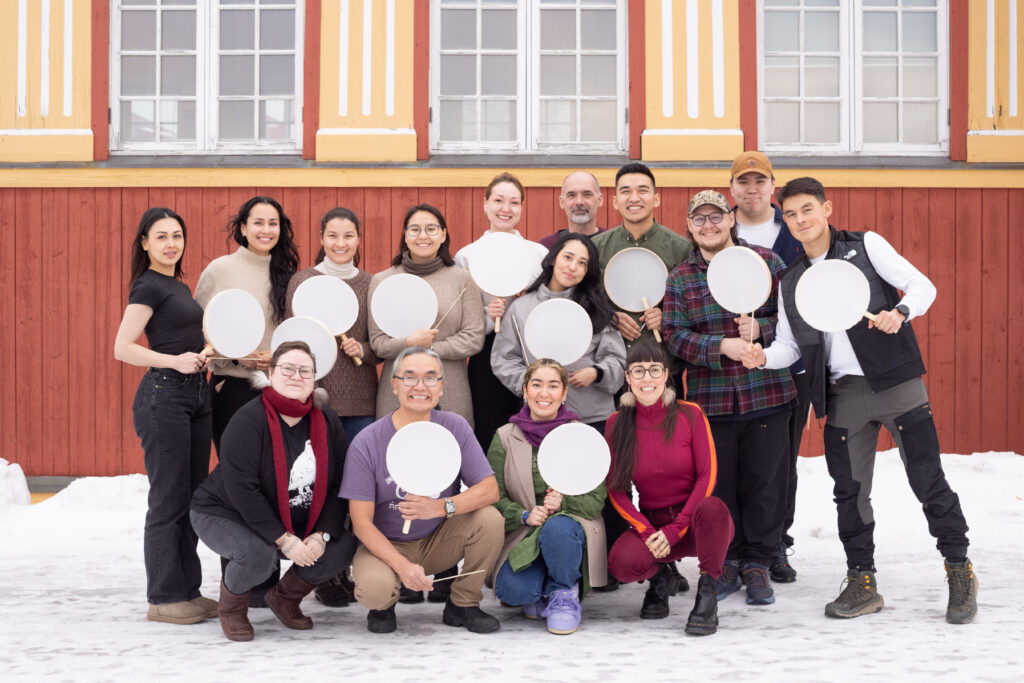
Eleven biology students in Nuuk will begin a course this November that brings seal hunting, food preparation and the knowledge of three generations of hunters into their university education.
PUISI, a course focused on seals at Ilisimatusarfik, the University of Greenland, starts November 9, 2026 and runs for nine weeks. Aviâja Lyberth Hauptmann, head of the university’s SILA department, told GreenlandEnergy.com that plans include listening sessions with hunters from three generations and hunting trips led by at least four hunters, with students working in groups of two or three.
The teaching forms part of SILA’s partnership with Oceans North Kalaallit Nunaat, ONKN. The collaboration recognizes academic knowledge, hunters’ and fishers’ experience, and Indigenous knowledge as different but equally valuable and complementary. As Sermitsiaq reported on August 30, ONKN funding will help compensate contributors, support fieldwork logistics and develop teaching materials.

For PUISI, hunters will serve as guest instructors and teach students in the field, including how to hunt seals, handle the catch and prepare it for food. Fishers will be central to KINGUPPAK, a course focused on shrimp and halibut planned for 2027.
Hauptmann wants the hunters and students to get to know one another, allowing hunters to decide what knowledge they share and help shape what students learn.
She described a guiding question for the hunters: “What do you want future biologists in Kalaallit Nunaat to know?”
Asked how SILA would handle differences between Indigenous knowledge and conventional biological research, Hauptmann said students should understand the methods, motivations, incentives and experiences behind both scientific and community observations. She wants them to examine all data critically and recognize its limitations.
Her approach has roots in her own life and research. Born in Nuuk to an Inuit mother and a Danish father, Hauptmann grew up in Sisimiut before moving to Denmark at age 10. She later returned to Greenland after completing her doctorate. In an interview with MAD Digest, she described noticing that the food culture she came from was missing from the microbiome research around her.
Her research explores the microorganisms carried by traditional foods and their possible relationship with the gut microbiome, the community of microorganisms living in the digestive tract. A 2020 study she led mapped microbes in foods associated with Inuit hunting, including dried muskox and caribou meat. Laboratory measurements supported local judgments about when the meat was sufficiently dry to limit microbial growth under the conditions studied.
A 2026 pilot study she coauthored tracked substantial changes in gut microbial composition during a transition to an Indigenous Greenlandic diet over 12 weeks. The findings are exploratory: the study followed one adult whose physical activity also increased substantially, so the changes cannot be attributed to diet alone.
That research sits alongside her own experience of hunting and learning from communities. In a profile published by Imagine5, Hauptmann recalled a muskox hunt with relatives in 2017, carrying roughly 30 kilograms of meat back to camp. Exhausted and shaking, she felt an accomplishment comparable to completing her Ph.D.
The same profile describes her research into traditional fermented food in Siorarpaluk, where residents initially met her work with suspicion. Relationships developed as she demonstrated respect for their knowledge. “They are the experts and I need their help,” she told Imagine5.
The ONKN partnership builds on teaching practices already present across SILA’s courses, Hauptmann said. She also told GreenlandEnergy.com that the department had been awarded a separate grant of DKK 1.7 million to take all second year students to Qaanaaq for three weeks to learn from the hunting community there.
“All the courses in SILA have similar elements,” she wrote. “Through the collaboration with ONKN we are able to develop it even further.”
GreenlandEnergy.com provides independent analysis of Greenland’s energy landscape, critical minerals development, and Arctic geopolitics. For corrections or feedback: press@greenlandenergy.com
READ NEXT: Greenland Sealskin Initiative Began After Future Greenland Conference, Months Before Oil Permit Delay