Greenland Energy Company chairman Larry Swets says the idea of opening the United States market to Greenlandic sealskin products began taking shape in late May, shortly after he returned from the Future Greenland conference in Nuuk.
Swets described the initiative’s origin during a 90-minute telephone interview with GreenlandEnergy.com on August 20. A person familiar with its early development, speaking on condition of anonymity, separately identified a June 7 text message exchange as the earliest discussion known to them.
The Future Greenland conference was held May 19–20 at Katuaq in Nuuk. The official participant list records both Swets and Greenland Energy chief executive Robert Price among those registered for the company.
How the question arose
Swets said that after returning to Chicago he first considered supporting local charities and began asking Greenlanders what would make a substantial difference in their communities.
Five suggestions came back. Sealskins were at the top.
He said he came to understand that removing U.S. barriers to Greenlandic sealskin products could produce an immediate benefit for hunters and the settlements they support. The idea developed quickly. He began researching the question and participated in the development of what became Sealskin Diplomacy, a 36-page white paper addressed to the Executive Office of the President and the U.S. Department of State.
The public statement
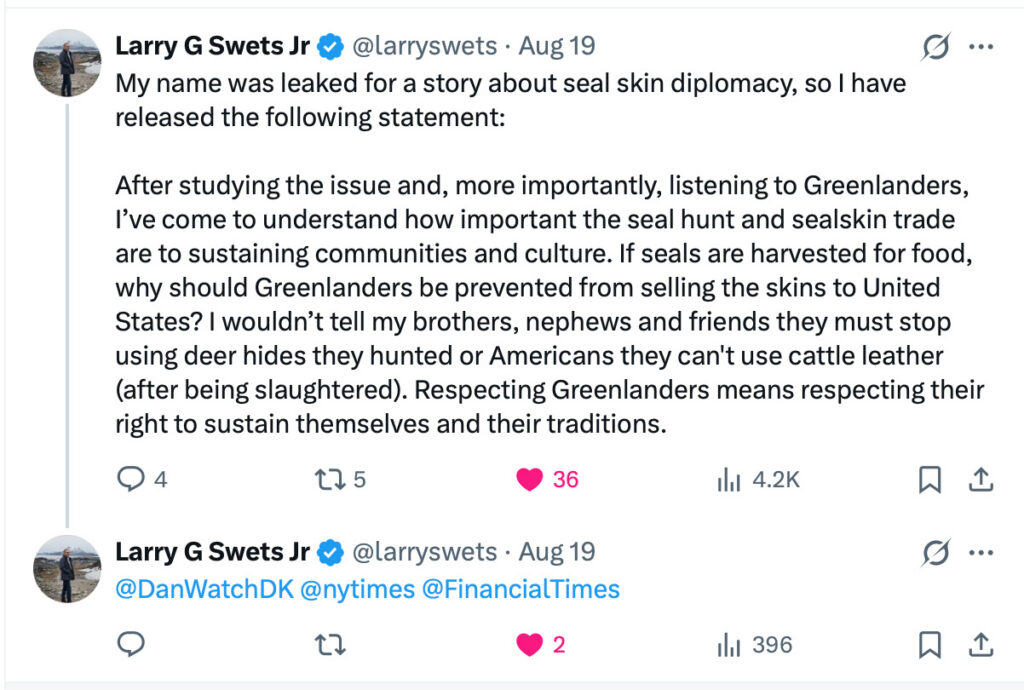
Swets set out his position publicly on August 19, writing that his name had been leaked in connection with a story about the paper.
He said that after studying the issue and, more importantly, “listening to Greenlanders,” he had come to understand how important the seal hunt and the sealskin trade are to sustaining communities and culture. If seals are harvested for food, he asked, why should Greenlanders be prevented from selling the skins to the United States? He compared the position to American use of deer hides and cattle leather, and wrote that respecting Greenlanders means respecting their right to sustain themselves and their traditions.
In a follow-up post, Swets tagged Danwatch, The New York Times and the Financial Times.
Price, asked separately about the motivation behind the proposal, said Swets wanted to “champion” the initiative.
“It came from Larry’s heart for the people of Greenland,” he told GreenlandEnergy.com.
Price is chief executive of the company Swets chairs.
What the accounts rest on
During the interview, Swets checked his browser history to determine when his research began. He said it showed searches dating from late May, shortly after the conference. GreenlandEnergy.com did not independently review those records.
A person familiar with the initiative’s early development said the earliest discussion of it known to them occurred in a text message exchange dated June 7, 2026. GreenlandEnergy.com has not reviewed the message. The source’s account establishes that the initiative was under discussion by June 7 but does not address when the idea first arose.
Neither account has been corroborated by documentation reviewed by this publication.
Sequence
May 19–20, 2026 — Future Greenland conference in Nuuk. Swets and Price registered for Greenland Energy Company.
Late May — Swets dates the start of his research to this period.
June 7 — Earliest discussion identified by a person familiar with the initiative.
August 11 — Greenland Energy Company files a Form 8-K with the Securities and Exchange Commission stating that the complexity of the permitting process requires a more extensive review, with the company and its partner, 80 Mile, now working toward a targeted permit timeline of winter 2027. The filing followed an indication from Greenland’s Mineral Resources Department that the approvals required for drilling would not be issued in time for the current season.
August 19 — Swets says publicly that his name has been leaked in connection with the paper and issues a statement.
August 20 — Swets is interviewed by GreenlandEnergy.com.
Both accounts place the initiative in motion before the permitting timetable changed.
The document
Sealskin Diplomacy runs 36 pages with six annexes and contains a statutory analysis of the Marine Mammal Protection Act, draft legislation, an outline executive order and a draft charter for an Arctic scientific body. It proposes limiting eligible U.S. imports to no more than 30,000 specimens a year and increasing the value recovered from seals already harvested for food, rather than encouraging a larger harvest.
At its core, the proposal seeks to ensure that Greenlanders receive more value from seals already harvested for food. Allowing qualifying skins from that existing harvest to enter the U.S. market could provide additional income to hunters and their communities without requiring an expanded harvest. The serious policy questions concern traceability, conservation safeguards and enforcement: whether imports can be reliably confined to Inuit-produced goods from lawful, sustainable hunts. If those conditions can be met, denying Greenlandic hunters access to additional value from the existing harvest becomes difficult to justify.
Editor’s note: GreenlandEnergy.com received Sealskin Diplomacy directly from Larry Swets. GreenlandEnergy.com interviewed Swets by telephone on August 20, the day after he issued a public statement about the paper, and separately interviewed Greenland Energy Company chief executive Robert Price. These were the publisher’s first telephone conversations with either executive.
GreenlandEnergy.com has received no payment from Greenland Energy Company, or any party connected to the white paper, and no commercial agreement is in place. Neither GreenlandEnergy.com nor its publisher holds a position in any company named in this article. GreenlandEnergy.com retained complete editorial control over this reporting.
GreenlandEnergy.com provides independent analysis of Greenland’s energy landscape, critical minerals development, and Arctic geopolitics. For corrections or feedback: press@greenlandenergy.com
READ NEXT: Pituffik Space Base Marks 75 Years as New Commander Takes Charge