Opinion
Greenland should draw a clear biological line: honey and other finished bee products may enter the country. Live honeybees should not.
To protect the limited pollen and nectar supply on which Greenland’s native pollinators depend, Greenland should permanently prohibit the importation of live honeybees.
Finished bee products intended for human use should remain available through trade, subject to product specific food safety and biosecurity controls. Greenland can obtain honey, finished wax products, propolis and pollen without importing an agricultural animal capable of reproducing and competing with native species.
I write this as someone who has kept honeybees for years. Honeybees do not enter a landscape as isolated pollinating insects. One colony can contain tens of thousands of coordinated workers capable of identifying the richest sources of nectar and pollen and directing large numbers of foragers toward them.
That efficiency makes honeybees valuable agricultural livestock. It can also turn a colony into a formidable competitor when introduced into an ecosystem with a short flowering season and limited floral resources.

Removing a honeybee colony after a swarm entered a building cavity.
Native insects are already under pressure
An article published by Sermitsiaq on August 29, 2026 highlighted research showing that many of Greenland’s insects and other terrestrial arthropods may struggle to adapt as the Arctic warms.
The study, published in Global Change Biology, examined the upper and lower thermal limits of 93 species of insects, spiders and springtails collected in South Greenland. The researchers found strong phylogenetic patterns in heat tolerance and thermal scope, which they argue may limit evolutionary adaptation to rising and increasingly variable temperatures.
About one quarter of the species with measured upper thermal limits may periodically experience temperatures exceeding those limits under the study’s end of century projection. The results suggest that climate change will produce substantial changes in the distribution and abundance of terrestrial arthropods in South Greenland.
Flies had the lowest median upper thermal limit among the major groups examined. They are also likely Greenland’s most important pollinators.
Only two bumblebee species have been recorded in Greenland. Muscid flies, particularly those belonging to the genus Spilogona, are more abundant and frequent flower visitors. At the Zackenberg research station in East Greenland, long term monitoring has recorded declines of more than 80 percent in muscid fly diversity and abundance in some habitat types, according to the NOAA Arctic Report Card.
Collectively, Greenland’s terrestrial arthropods pollinate plants, break down organic material, release nutrients into the soil and provide food for birds and mammals. They form part of the biological foundation of the country’s terrestrial food web.
Honeybees have already been collected at Narsarsuaq
During fieldwork at Narsarsuaq in August 2023, the western honeybee, Apis mellifera, was among the species collected from a grass and shrub covered survey area measuring 200 by 200 meters beside the researchers’ laboratory.
Honeybees were not included in the thermal tolerance experiment because they were physically too large for the researchers’ equipment.
Greenland’s only publicly documented apiary was still operating at Narsarsuaq in July 2024, although its current status has not been confirmed.
The study was not designed to measure competition between pollinators and provides no evidence that the Narsarsuaq apiary harmed native insects. Its finding is narrower: an introduced social pollinator was present in the same South Greenland survey landscape as arthropods now facing increasing heat stress.
Greenland’s scarcity of large, hollow trees makes it difficult for escaped swarms to establish permanent feral colonies. Establishment is not impossible, however. Honeybees can occupy cavities inside buildings and other sheltered spaces.
Narsarsuaq is also unusual because it contains a 150 hectare arboretum with approximately 110 species of trees and shrubs. As those trees mature, future nesting opportunities cannot be dismissed completely.
More importantly, managed honeybees do not need to find wild nesting sites. Colonies can remain inside protected hives, receive winter food and other assistance and send thousands of workers into the surrounding landscape each summer.
The principal concern is therefore not an imminent invasion by feral honeybees. It is the artificial expansion of a managed population that Greenland’s environment might never support without continued human assistance.
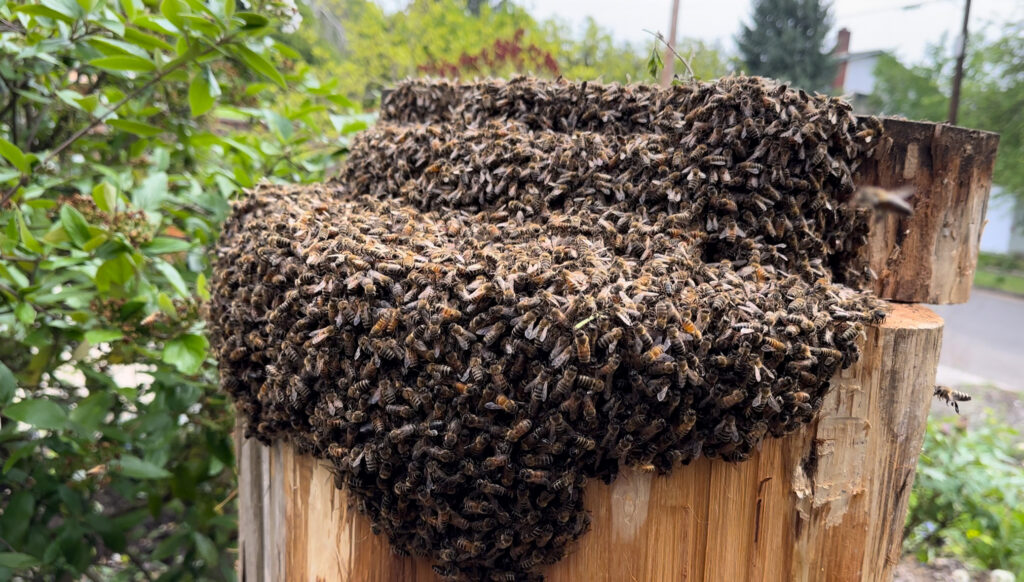
A honeybee swarm.
An agricultural animal, not a conservation measure
Honeybees enjoy an exceptionally positive public image. Campaigns to “save the bees” often treat honeybees and native pollinators as though they were interchangeable.
They are not.
The western honeybee is a managed agricultural animal. In Greenland it is an introduced species. Its ability to communicate the location of productive flowers allows a colony to concentrate thousands of workers on the best available forage.
Research into competition between managed and native bees has produced varying results, depending on the species, habitat and availability of flowers. A systematic review of 146 studies found that 53 percent of competition studies reported negative effects on native bees. Twenty-eight percent reported no effect and 19 percent reported mixed results.
The review also identified potential risks from pathogen transmission. Seventy percent of the pathogen studies reported negative effects, although most did not establish the direction of transmission or measure lasting population effects on native bees.
More recent evidence has made the competition concern harder to dismiss. On Giannutri, an isolated Italian island, researchers monitored the two most abundant native bee species after a seasonal honeybee apiary began operating there in 2018. Both native bee populations declined by approximately 80 percent during four years of monitoring from 2021 through 2024.
On selected experimental days, researchers closed the entrances to 18 full sized honeybee hives for 11 hours. Nectar volume subsequently increased by approximately 60 percent and pollen availability by approximately 30 percent. The native bees also increased their foraging activity and collected floral resources more efficiently.
The authors of the 2025 Current Biology study concluded that their results demonstrated competition for floral resources between the managed honeybees and the declining native bee populations. They also acknowledged that other unmeasured factors, including pathogen transmission, might have contributed to the declines.
Greenland should learn from that experience rather than reproduce it.
Food security requires restraint
Greenland’s experience with beekeeping has demonstrated that honeybees can survive and produce honey at Narsarsuaq. In good years, a single colony has reportedly produced between 50 and 80 kilograms.
If colonies remain active at Narsarsuaq, this proposal is not a call for their destruction. Any surviving hives should be addressed separately through monitoring and regulation.
The policy question is whether Greenland should permit additional live honeybees, queens or reproductive material to enter the country if warmer conditions increase interest in beekeeping.
It should not.
A domestic honey industry might create a valuable niche product, but its contribution to national food security would be small. Greenland must weigh that benefit against the risks of increased competition, introduced bee diseases and lasting disruption of native pollination networks.
Food security does not require producing every possible commodity locally. It also requires reducing vulnerability and protecting ecological processes, including pollination and nutrient cycling, that sustain terrestrial food webs.
Retail honey keeps well and can be imported for human consumption. Finished wax, propolis and pollen products can also be traded under product specific food safety and biosecurity controls.
Imported honey or pollen should never be fed to any surviving colonies. Feeding honey or pollen of uncertain origin to bees can transmit disease.
Raw comb, bulk untreated pollen, wax intended for use inside hives and used beekeeping equipment should remain outside the country unless validated treatment and certification demonstrate that they present no bee disease risk. The spores responsible for American foulbrood can spread through contaminated honey and wax, remain viable for many years and persist on beekeeping equipment, according to the World Organisation for Animal Health.
Greenland already requires permission for the importation of animals. It should go further and establish an explicit permanent prohibition covering live honeybees and honeybee reproductive material.
Greenland’s scarcity of suitable nest cavities currently provides a natural barrier against permanent feral honeybee populations. The country should preserve that advantage by closing the door to further live imports, not treat a low risk of feral establishment as evidence that additional managed colonies would be ecologically harmless.
Honey is a product. Honeybees are a biological intervention.
Greenland should import one and ban the other.
GreenlandEnergy.com provides independent analysis of Greenland’s energy landscape, critical minerals development, and Arctic geopolitics. For corrections or feedback: press@greenlandenergy.com
READ NEXT: Greenland Hunters’ Association Calls for U.S. Sealskin Import Ban to Be Lifted