Greenland’s national association for professional fishers and hunters wants the United States to lift its restrictions on sealskin imports, saying access to the American market would increase demand and provide additional income for hunters.
In a statement provided to GreenlandEnergy.com, KNAPK (Kalaallit Nunaanni Aalisartut Piniartullu Kattuffiat) acting chief executive officer Niels Boassen said the organization sees clear economic potential in the United States.
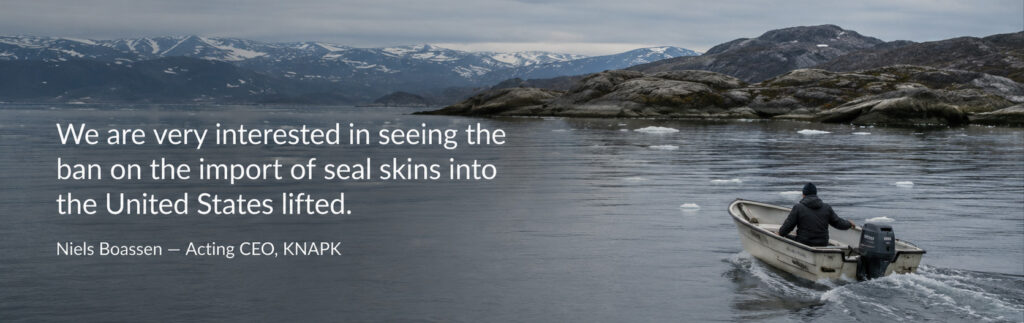
“We are very interested in seeing the ban on the import of seal skins into the United States lifted. Last year, despite the ban, seal skins worth DKK 480,000 were sold to the United States, which clearly shows that there is demand.”
DKK 480,000 is equivalent to approximately $75,000 at current exchange rates.
KNAPK said lifting the restrictions would create greater demand for hunters’ skins and increase income for both hunters and Great Greenland.
Great Greenland A/S is wholly owned by the Greenland Self-Government and purchases sealskins from hunters along Greenland’s coast. The company describes preserving the profession of seal hunting as one of its central responsibilities.
KNAPK did not explain how the reported sales were completed under existing U.S. restrictions, and GreenlandEnergy.com has not independently verified the DKK 480,000 figure.
Current U.S. federal regulations generally prohibit the importation of marine mammals and marine mammal products except where specific exemptions or permits apply.
What access to the American market could change
Opening the United States market would not guarantee higher prices for hunters. However, additional demand for a limited and certified supply would normally be expected to put upward pressure on the value of qualifying Greenlandic sealskins.
How much of that additional value ultimately reaches hunters would depend on the prices paid for their skins, along with processing, certification, marketing and distribution costs.
The experience of the European Union shows that legal access alone may not be enough. Qualifying Greenlandic seal products can be placed on the European market under an Indigenous communities exemption, but the European Commission reported that the broader ban led to a large decline in sales of Greenlandic sealskins.
Consumer stigma surrounding seal products therefore remains a serious commercial challenge. Opening a market creates an opportunity, but demand must still be developed.
A different market from 1972
Any reopening of the United States market would take place in a commercial environment vastly different from the one that existed when the Marine Mammal Protection Act was enacted in 1972.
Ecommerce, social media and modern communications can allow Greenlandic hunters, artisans, cooperatives and local businesses to reach American consumers directly, reducing their dependence on traditional wholesale fur markets and multiple layers of intermediaries. They also give Greenlanders greater control over how their products and traditions are presented, allowing hunters and Indigenous makers to explain that seals are harvested primarily for food and show how a purchase benefits a Greenlandic community.
Selling directly to consumers could allow a greater share of the final retail value to remain in Greenland, particularly when skins are transformed into finished clothing, accessories or other products by Greenlandic businesses before export.
Technology could also strengthen traceability and consumer confidence. The United States would not be starting entirely from scratch. Wildlife shipments are already declared through the U.S. Fish and Wildlife Service import system, while Alaska’s Silver Hand program helps consumers identify authentic Alaska Native artwork. However, neither provides a unified consumer certification system for commercially traded Greenlandic sealskin products.
The European Union already allows recognized certification bodies to attach QR codes to qualifying Indigenous seal products, allowing their origin and certification to be verified. A future American framework could combine existing federal import documentation with similar product level digital traceability, enabling consumers to verify a Greenlandic product’s origin, legal status and connection to a sustainable Indigenous harvest.
KNAPK emphasizes sustainability
Boassen also said Greenland could accommodate additional demand without exceeding sustainable harvesting levels.
“In Greenland, we have a large quota for seals, and there are more seals that we can harvest sustainably than we could ever possibly hunt.”
The statement frames access to the United States as a way to recover more economic value from Greenland’s existing seal hunt rather than as a reason to substantially expand it.
That argument closely matches the central premise of Sealskin Diplomacy, a policy paper running 36 pages that GreenlandEnergy.com received and reviewed. The paper proposes a regulated route for qualifying Greenlandic sealskin products to enter the United States.
The paper contains six annexes, a statutory analysis of the Marine Mammal Protection Act, draft legislation, an outline for a possible executive order and a draft charter for an Arctic scientific body. It proposes limiting eligible imports to no more than 30,000 specimens annually, supported by traceability, conservation and enforcement safeguards.
Support for U.S. market access
KNAPK’s statement marks an important development in the discussion surrounding the Greenland Sealskin Initiative.
Until now, much of the public attention has focused on Greenland Energy Company chairman Larry Swets and the circumstances surrounding the proposal.
GreenlandEnergy.com reported on August 21 that Swets began exploring the issue after attending the Future Greenland conference in Nuuk in May.
Swets said he asked Greenlanders what could make a meaningful difference in their communities and received five suggestions, with sealskins at the top of the list.
The KNAPK statement provides direct support from an organization representing the people the proposal is intended to benefit. KNAPK describes itself as Greenland’s business association for professional fishers and hunters and has 70 local branches across the country.
However, the statement contains no reference to Greenland Energy Company, Swets, the white paper or its proposed annual limit. It therefore represents support for opening the United States market, rather than a formal endorsement of the company or every element of the policy proposal.
For KNAPK, the nationality of the buyer is secondary to the economic benefit received in Greenland.
“Whether our skins are purchased by the EU or the United States is of little importance to us, as long as it results in increased income for the hunters and Great Greenland.”
Editor’s note: GreenlandEnergy.com received the English and Danish KNAPK statement through a communications representative for Greenland Energy Company, who confirmed that it could be published.
GreenlandEnergy.com has received no payment from Greenland Energy Company or any party connected to the sealskin proposal, and no commercial agreement is in place. Neither GreenlandEnergy.com nor its publisher holds a position in any company named in this article. GreenlandEnergy.com retained complete editorial control over this reporting.
GreenlandEnergy.com provides independent analysis of Greenland’s energy landscape, critical minerals development, and Arctic geopolitics. For corrections or feedback: press@greenlandenergy.com
READ NEXT: Greenland Sealskin Initiative Began After Future Greenland Conference, Months Before Oil Permit Delay