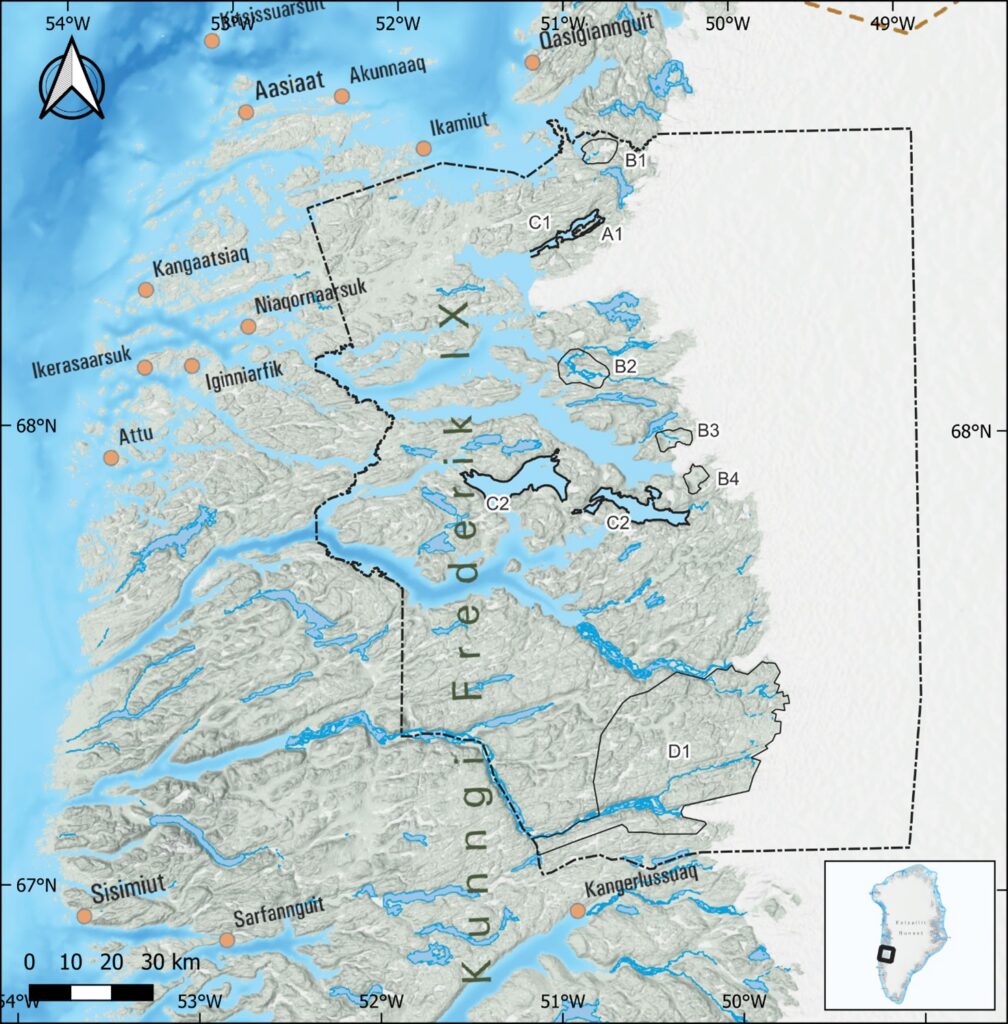
Greenland has officially opened Pilivik National Park, a protected area covering 22,249.80 square kilometers between Kangerlussuaq and Disko Bay.
The park is Greenland’s first new national park in more than 50 years and the first developed by Greenland itself, according to the Government of Greenland.
Pilivik was officially inaugurated on September 14 at Reindeer Glacier near Kangerlussuaq. The ceremony brought together residents, government representatives and the mayors of Kommune Qeqertalik and Qeqqata Kommunia.
“With the opening of Pilivik National Park, Greenland gains the first national park that we have created ourselves,” said Jørgen Rosbach, minister for environment, nature, energy and research. “Together, we will protect our unique natural environment and manage the area so that it can be used and experienced by present and future generations.”
Pilivik stretches from the outlet glaciers of the Greenland Ice Sheet to coastal landscapes along deep fjords. The area will remain open to the public, while traditional hunting, fishing and berry picking can continue.
Only a small number of clearly defined areas will be subject to seasonal protections intended to safeguard vulnerable wildlife, including harbor seals, greater white fronted geese, sea ducks and caribou.
Local Use Will Continue
The two municipalities began pursuing the national park in 2020, working with the WILD Nature Foundation. Information gathering, public meetings held in 2022, 2023 and 2025, and a public consultation conducted from December 2025 through March 2026 helped determine the park’s boundaries and regulations.
Qeqqata Kommunia Mayor Malik Berthelsen emphasized that Pilivik was created through a local initiative and will remain a living landscape used by the people who depend upon it.
“Pilivik is not a national park that excludes people. On the contrary,” Berthelsen said. “Traditional hunting, fishing and gathering will continue as a natural part of life in the area.”
He said the park demonstrates that protecting nature and respecting the people and traditions connected to the landscape can be pursued together.
For thousands of years, the region has provided food, knowledge and identity to successive generations. The name Pilivik, roughly meaning “a place of provisions” or “natural storehouse,” reflects the area’s longstanding importance as a source of winter food, including caribou, muskoxen and Arctic char. The name was selected through a public competition held in June and July.
The resident who proposed the name described the area as one of the most important places for obtaining winter provisions of caribou, muskoxen and Arctic char. It continues to serve as a harvesting area today.
Pilivik will be the collective name for the national park, but existing names for fjords, mountains, hunting grounds and other locations will remain unchanged.
Tourism and Local Employment
Berthelsen also identified sustainable tourism as an important opportunity created by the park.
“There is significant potential to develop sustainable nature tourism that creates local jobs and new opportunities for our citizens,” he said. “More people will have the opportunity to experience this remarkable area, but this must happen on nature’s terms and in a way that respects local communities.”
Pilivik complements the Aasivissuit–Nipisat UNESCO World Heritage Site, which preserves a cultural hunting landscape extending between the Greenland Ice Sheet and the sea.
Aasivissuit–Nipisat contains evidence of approximately 4,200 years of human history, including hunting, fishing, gathering and seasonal migration. Berthelsen said the World Heritage Site and national park together create an exceptional area where visitors can experience both Greenland’s natural environment and its continuing cultural heritage.
Kommune Qeqertalik Mayor Simigaq Heilmann said the opening celebrates several years of cooperation among residents, municipalities and Naalakkersuisut. She said Pilivik should create local value while supporting tourism that respects the area’s traditional use.
GreenlandEnergy.com provides independent analysis of Greenland’s energy landscape, critical minerals development, and Arctic geopolitics. For corrections or feedback: press@greenlandenergy.com
READ NEXT: Greenland’s Future Biologists Will Learn From Three Generations of Hunters