
Opinion
On September 20, Tusass reported that all connections to Upernavik had been interrupted and technicians were traveling by helicopter to a radio relay site. The notice also described unstable connections in Uummannaq and surrounding areas. The incident was subsequently marked resolved on the company’s official service-status page.
Tusass’s service status page listed 10 unplanned service disruption notices dated September 7–20, including follow up updates and reports of partial failures affecting internet, mobile services, international text messaging, and aviation and maritime radio.
In April 2024, Tasiilaq regional physician Hans Christian Florian Sørensen described to Sermitsiaq how a temporary Starlink installation at the hospital had made access to electronic patient records much faster. According to Sermitsiaq’s report, the hospital switched back to Tusass after questions arose over Starlink’s legality, and Sørensen said poor performance returned.
“We waste enormous amounts of time on poor internet connections,” he told Sermitsiaq, translated from Danish. The newspaper also reported that the regulator had referred installer Inu:it to police for allegedly breaching Tusass’s exclusive rights.
Earlier that month, Sermitsiaq reported that Jan Joe Seidsen’s Facebook campaign against the monopoly had attracted more than 600 comments and 700 shares. His proposed Starlink giveaway encouraged people to comment “Stop Tusass Monopol.” He wanted politicians to permit alternatives, particularly outside towns, in fjords and at sea.
Tusass responded to the doctor’s criticism on April 25, 2024. It acknowledged problems in satellite-served areas, said it was discussing possible cooperation with Starlink and other providers, and emphasized Greenlandic control of critical infrastructure. It also stressed that changing telecommunications law was Parliament’s responsibility.
For ordinary broadband access, the regulator’s published guidance states that end users who independently install equipment and use services such as Starlink are acting illegally under the Telecommunications Act. Tusass holds exclusive rights to provide satellite services to Greenlandic end users, subject to legal exemptions.
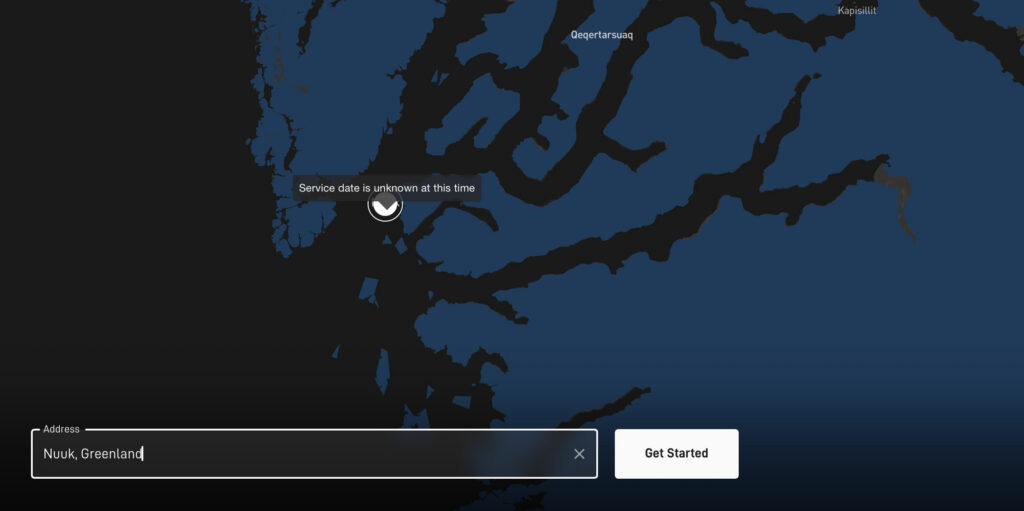
When GreenlandEnergy.com checked Starlink’s availability map for Nuuk and Ilulissat, it displayed: “Service date is unknown at this time.” The message provided no launch timetable or explanation.
The regulator explains that Tusass’s exclusive rights help fund nationwide service. Serving Greenland’s small, scattered population is expensive, and revenue from more densely populated areas helps support infrastructure in remote communities. Any proposal to allow independent alternatives needs to consider how that coverage would be funded.
There is already an exemption for emergency and safety communications, extended to land use from January 1, 2025. The government’s explanatory notes describe citizens’ use of services such as InReach, Iridium and personal locator beacons for safety purposes. However, those provisions do not expressly authorize Starlink as a general household broadband backup.
For visitors considering a Starlink Mini, the practical advice is to check before connecting. The current law contains no general tourist exemption, so travelers should confirm the rules with Telestyrelsen rather than assume a subscription purchased abroad permits use in Greenland.
On September 7, 2026, Eutelsat announced an expanded project with Tusass, supported by the EU, Greenland and Denmark, to connect remote communities and critical infrastructure. OneWeb’s low Earth orbit satellites could deliver faster, more responsive connections in those areas.
Tusass itself uses backup connections. A September 17 notice said Savissivik would operate through Greensat while its OneWeb connection was switched off for a supplier to address a fault. That illustrates both the operational challenges and the value of having another route available. Tusass service updates
As Greenland seeks to expand tourism and attract new businesses and investment, its communications network will need to keep pace. The real test for Tusass’s OneWeb partnership will be whether it delivers the capacity and reliability that growth requires. Let’s hope it does. Strengthening the network and allowing independent backups would both help residents and businesses prepare for that future.
GreenlandEnergy.com provides independent analysis of Greenland’s energy landscape, critical minerals development, and Arctic geopolitics. For corrections or feedback: press@greenlandenergy.com
