Ilulissat, whose name means “icebergs” in Greenlandic, is preparing to become one of Greenland’s most important international gateways.
Greenland’s third largest town had 5,150 residents at the beginning of 2026. On Oct. 29, it is scheduled to open a new international airport with a 2,200 meter runway, a passenger terminal, a technical building and a control tower. The existing 845 meter runway will become part of the airport access road.
For residents of Ilulissat and communities across North Greenland, the airport promises shorter journeys and more direct access to Copenhagen and the rest of the world. For local businesses, it opens the door to a longer tourism season, greater regional activity and new opportunities in aviation services, research, construction and logistics.
The change will also place Ilulissat within easier reach for American travelers, investors and technical teams, whether they arrive through Iceland, Nuuk or Denmark. No direct U.S. route has been announced, but the practical and economic distance between North Greenland and the United States is already shrinking.
A new scale of access
The airport project has entered its final phase. Greenland Airports reported that the runway and buildings were handed over in November 2025. Since then, work has focused on interiors, equipment installation, testing, training and the final approvals required for opening.
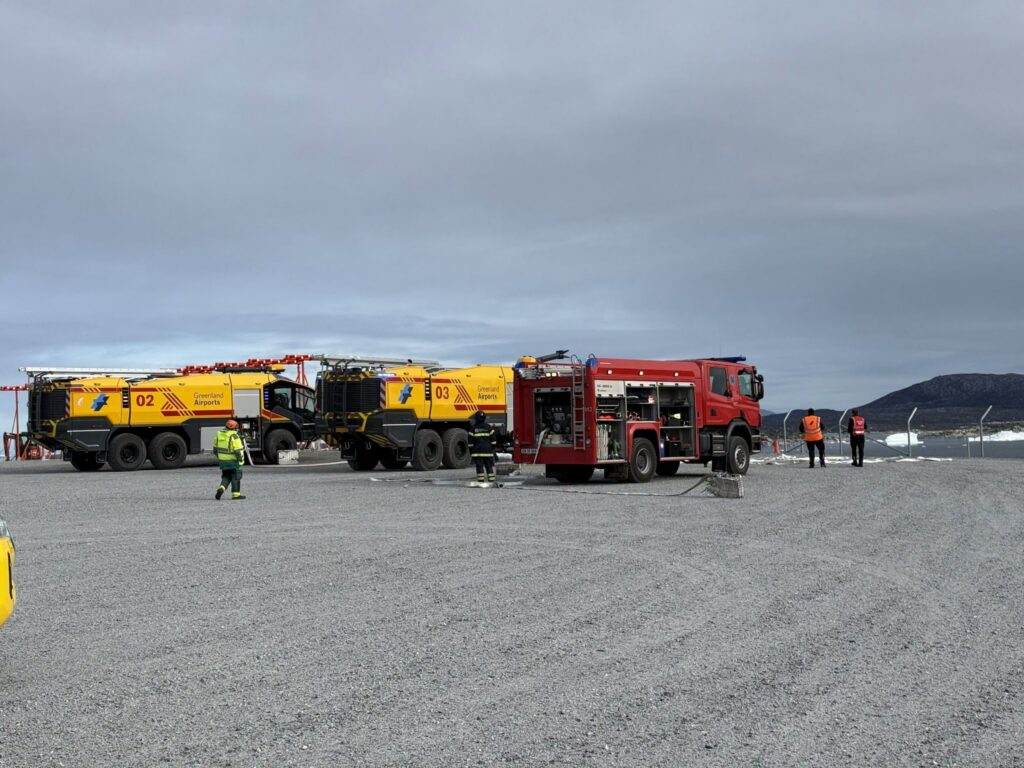
During a recent emergency preparedness exercise at Ilulissat Airport, Greenland Airports worked with police, healthcare personnel and local emergency services to test their response to several major incident scenarios. The airport operator described the exercise as an important step toward the opening at the end of October and emphasized that effective aviation safety depends on coordination with the wider community as well as airport procedures.
The timetable appears firm enough for airlines to sell tickets, although Oct. 29 remains a scheduled opening date subject to the completion of those final steps.
Ilulissat already has a direct international flight. Icelandair’s 2026 schedule lists seasonal service between Keflavík and Ilulissat from June 1 through Sept. 29, reaching as many as nine flights a week at peak.
The new airport changes the type and scale of service. Air Greenland plans to inaugurate a direct Copenhagen–Ilulissat route on opening day with its Airbus A330neo, Tuukkaq. Regular winter service will initially use a 180-seat Boeing 737-800 operated by Jettime, followed by Air Greenland’s leased Airbus A320neo, Unaaq, after it enters service in 2027.
Air Greenland’s winter plan provides one direct Copenhagen flight each Wednesday. The airline plans two weekly flights during Christmas and New Year and from March 1 through March 27, 2027. Its published summer 2027 timetable shows as many as six weekly Copenhagen–Ilulissat rotations during the peak period from mid-June into early September.
Using the initial 180-seat aircraft as a simple reference, six arriving flights would place up to 1,080 inbound seats a week into a town of 5,150 people. That is seat capacity, not a passenger forecast, and many travelers will move onward. Even so, it illustrates the potential scale of change.

What the airport could deliver for residents
Ilulissat will become a more important gateway for Aasiaat, Uummannaq, Upernavik, Qaanaaq and smaller communities across North Greenland. Air Greenland has designed parts of its winter schedule around same-day connections, although some itineraries will still require an overnight stay in Ilulissat.
Tourism offers the most visible commercial opportunity. Ilulissat combines the UNESCO-listed Icefjord, dog-sled culture, whale watching, hiking, sailing and a growing winter market. Easier direct access from Copenhagen could lengthen the season and support more year-round work rather than concentrating income in a short summer surge.
Tourism directly contributed DKK 1.245 billion, or 4.9% of Greenland’s GDP, in 2024, according to Greenland’s first Tourism Satellite Account. It supported an average of 1,800 jobs. International visitors accounted for 58% of almost DKK 3 billion in total tourist spending.
The airport will also strengthen construction, maintenance, ground handling, passenger services and regional distribution. Improved international access will support nearby mineral exploration as well. 80 Mile has maintained a logistical base in Ilulissat since 2016 for its Disko-Nuussuaq nickel, copper, cobalt and platinum group metals project, where drilling began in July. The Nordic Investment Bank, which helped finance the Nuuk and Ilulissat airport program, said the infrastructure was intended to reduce market barriers and expand opportunities in fisheries, mineral production, ecotourism and research.
Connections to the United States
Icelandair already markets through itineraries from multiple American cities to Ilulissat via Keflavík. For travelers who also want to experience Iceland, the connection becomes an advantage rather than an inconvenience. Icelandair allows passengers to add a stopover of up to one week at no additional airfare, making it possible to combine Iceland and Greenland in a single journey. Both flights use Keflavík International Airport, so no airport transfer is required. Icelandair says a New York to Ilulissat journey can take roughly 15½ hours, depending on the connection.
A second route now runs through Greenland’s capital. United Airlines resumed its twice-weekly seasonal Newark–Nuuk service on June 6, 2026, while Air Greenland operates several daily flights between Nuuk and Ilulissat. That route still requires a domestic connection and careful planning around weather and schedules.
For American companies, the strongest opportunities will come through local partnerships. Visit Greenland has emphasized keeping a greater share of tourism revenue in local communities and expanding local participation. Businesses that add capacity, develop Greenlandic skills and work with local operators will be well positioned as Ilulissat’s international reach grows.
Building Capacity Beyond the Runway
Travelers currently rely on taxis or hotel transfers. Growing passenger numbers could strengthen the case for public transportation while creating additional demand for road improvements, water, power, waste management and emergency services.
Accommodation will be one of the first areas to expand. A 2025 Nordregio study of Ilulissat found that tourism growth had already contributed to labor shortages, inadequate facilities and housing pressure, including homes moving into short-term visitor use.
Modular construction could provide one route to expanding that capacity more quickly. As GreenlandEnergy.com reported in July, French company Easycube is in advanced discussions with a Greenlandic mayor over its first accommodation project in the country. The proposed fully equipped 40-foot unit would house two people and arrive largely ready to connect, requiring limited civil work and simple foundations. Easycube sees the small project as a demonstration for potential wider deployment of accommodation, camps, technical buildings, clinics, workshops and warehouses. The company has not identified the municipality, and no connection to Ilulissat has been confirmed.
Municipal infrastructure will need to keep pace. Avannaata Kommunia’s published planning material, although dated, identifies the need for road improvements and records that some domestic sewage enters the sea without treatment. Growth in passenger volume will also increase pressure on water, power, waste management, taxis and emergency services.
Nuuk’s transition offers practical operational lessons. During the first half of 2025, after the capital shifted to its new international airport, Air Greenland recorded 59 jet-flight cancellations, compared with three a year earlier. The airline cited unusually poor weather along with icy runways and delays involving security, baggage and fuel delivery.
Ilulissat will have its own operating conditions, but the lesson is transferable. A runway opening is only one event in a much larger transition. Training, deicing, fuel, security, baggage, ground equipment, passenger care and hotel contingency capacity must work together from the first day.
Tourism growth will also require careful management of the natural environment. The Ilulissat Icefjord is a UNESCO World Heritage Site. UNESCO says visitor pressure, including crowding and erosion, remains concentrated in a relatively small area near town. A sharp increase in visitors could place more people onto the same paths, viewing points and boat routes unless tourism disperses across seasons and carefully managed sites.
For a town whose name means “icebergs,” the horizon is widening. Ilulissat’s new airport will open a new chapter as North Greenland’s international gateway, connecting the region to more of the world—and giving more of the world a reason to look north.
GreenlandEnergy.com provides independent analysis of Greenland’s energy landscape, critical minerals development, and Arctic geopolitics. For corrections or feedback: press@greenlandenergy.com
READ NEXT: Easycube Targets 2026 Deal for First Greenland Accommodation Unit