Few places on Earth carry as much geopolitical weight as a quiet former U.S. military base on Greenland’s western coast. Kangerlussuaq once a Cold War relic, and later Greenland’s main aviation gateway until Nuuk’s airport expansion shifted the hub is now rapidly reinventing itself as one of the most strategically important space communications gateways on the planet.
Lasers are just one part of the story. Kangerlussuaq is quietly attracting a wave of ambitious infrastructure interest, proposals that, if even partially realized, could reshape this Arctic outpost into a serious digital and logistics hub. But that story is for another day. Today, the lasers.
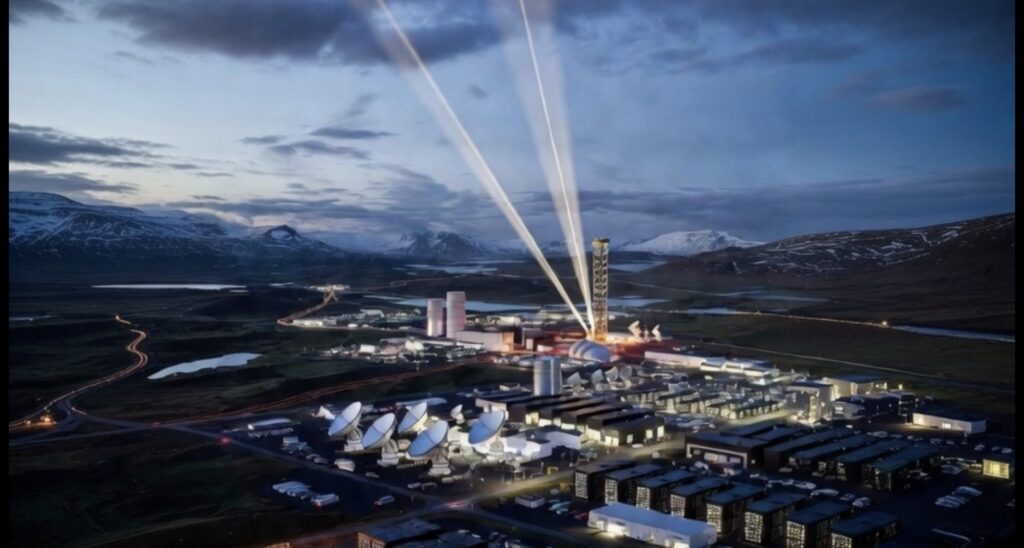
The catalyst: lasers
Lithuanian startup Astrolight, working with the European Space Agency (ESA), has begun building what is widely described as the world’s northernmost optical ground station. A facility that uses laser links rather than traditional radio frequencies to move data from satellites to Earth. The project is expected to be completed by the end of 2026.
The Catalyst: Lasers
Europe has long relied on radio based satellite ground infrastructure in the high north. That system is now straining under the weight of a satellite boom. By the early 2030s, tens of thousands of additional satellites (maybe over 100,000) are expected to be deployed and ground systems weren’t built for this scale.
At the same time, the security environment has shifted. Interference and disruption are no longer theoretical risks; they’re part of modern competition.
Laser communications change the equation. In Astrolight’s own framing, the Greenland optical ground station is designed to deliver more than 10x data throughput at over 70% lower cost per gigabyte versus commonly used RF ground stations.
The strategic advantage is resilience. A laser link is extremely narrow compared to RF broadcast, which can make it harder to detect, intercept, or disrupt in many scenarios. Some coverage has described the beam divergence on the order of a thousandth of a degree, underscoring just how tight the link can be.
Kangerlussuaq was chosen for good reason: its inland Arctic conditions are often described as unusually favorable for optical work, and its proximity to the pole means polar orbiting satellites pass frequently overhead. Geography, in this case, is destiny.

The Security Reality
Astrolight’s managing director for Denmark, Peter Stensgård Hansen, has pointed to a simple operational truth from military experience: with radio, the moment you transmit, you can advertise your presence. Optical links are being pursued partly because they can reduce that exposure while moving far more data.
Kangerlussuaq also sits inside a wider strategic map. Reporting and analysis have discussed Chinese linked satellite earth station activity associated with Kangerlussuaq/Greenland, described publicly in scientific or climate terms. One more reason communications infrastructure here draws attention.
ESA leadership has framed the Greenland station in sovereignty and resilience terms, language that, translated plainly, means: secure data links are now strategic infrastructure, and Europe wants more control of its own backbone.
What this means for Greenland
Kangerlussuaq was losing relevance. When Nuuk’s expanded runway opened in late 2024, Greenland’s aviation center of gravity shifted and Kangerlussuaq faced real uncertainty about what came next.
Now, within a short window, it has landed a flagship ESA-linked communications build, attracted new research activity, and pulled the attention of serious infrastructure minded players watching the Arctic’s next phase.
Astrolight CEO Laurynas Mačiulis has been direct about the ambition: this station is a first step toward a broader network. The lasers are just the beginning. Watch this space.
More on the broader transformation of Kangerlussuaq — including major data center proposals for the region — coming soon to GreenlandEnergy.com.
Greenland Energy provides independent analysis of Greenland’s energy landscape, critical minerals development, and Arctic geopolitics. For corrections or feedback: press@greenlandenergy.com