February 22, 2026 – The Arctic is witnessing a rapid convergence of military necessity and soft power diplomacy. Within a 48 hour window, a real world medical emergency in the North Atlantic has been followed by a major U.S. Presidential announcement.
The Submarine Medevac
On Saturday, February 21, the Danish Joint Arctic Command executed an urgent medical evacuation from a U.S. Navy submarine operating seven nautical miles off the coast of Nuuk. A Danish Seahawk helicopter retrieved a crew member requiring immediate acute care and transported them to a hospital in the capital. This incident underscores the extreme operational risks in Arctic waters, where even the world’s most advanced military vessels must rely on local, coordinated search and rescue (SAR) infrastructure.
Trump’s “Hospital Boat” Announcement
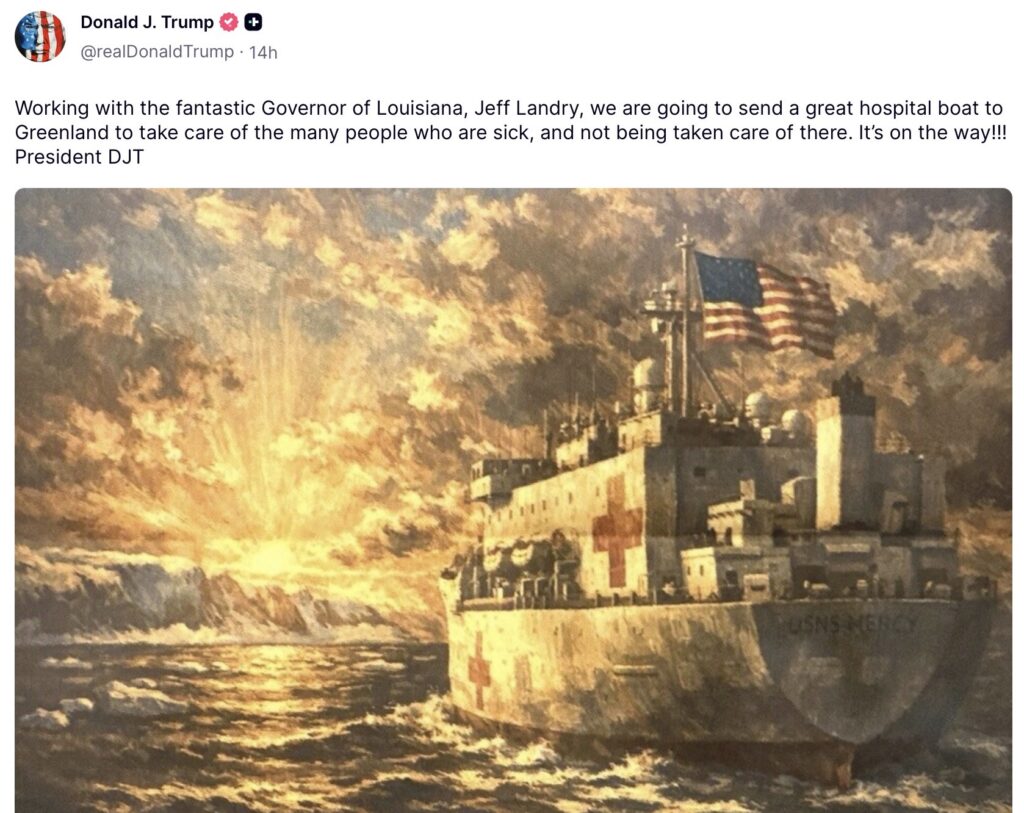
Shortly after the medevac, President Trump announced via Truth Social that the U.S. is dispatching a “great hospital boat” to Greenland.
- The Mission: Trump stated the vessel is being sent to “take care of the many people who are sick” and addressed alleged gaps in local healthcare.
- The Partnership: The initiative is being coordinated with Louisiana Governor Jeff Landry, the U.S. special envoy to Greenland.
- The Logistics: While the announcement featured an image of the USNS Mercy, both the Mercy and Comfort were last reported in drydock in Alabama for scheduled maintenance, according to GCaptain. Regardless of the specific vessel, the move signals a shift toward mobile, maritime based medical support in a region with zero connecting roads between settlements.
The Infrastructure Story Behind the News
While these events are being framed as humanitarian or military, they reveal a critical reality for the future of Greenland: the industrialization of the Arctic is currently outpacing its medical infrastructure.
The “Skilled Labor” Surge
As major projects like the Tanbreez Rare Earth Project move toward production in 2027 and the Jameson Land Basin drilling begins later this year, Greenland will see an influx of international skilled labor.
- Routine vs. Catastrophic: A workforce of thousands requires more than just local clinics; it necessitates advanced trauma capabilities to handle everything from routine appendectomies to catastrophic on-site industrial injuries.
- The Distance Problem: Currently, patients in remote villages must travel by plane or boat to Nuuk or even 3,500 km to Copenhagen for advanced imaging and surgery.

The Mobile Solution
In a territory where 80% of the land is ice covered and towns are isolated by fjords, a mobile medical vessel may be the only logical answer to the “Infrastructure Gap”.
- A Hub for Industry: A dedicated medical ship could serve as a floating safety hub for drilling platforms and remote mining camps along the coast.
- De-Risking Investment: For operating companies the presence of reliable, high tier medical support is a major de risking factor for labor recruitment.
The Bottom Line: Whether the hospital boat is a diplomatic olive branch or a strategic asset, it highlights that the road to Greenland’s energy independence will be paved across the water and air, not across the land. At least for the foreseeable future.
Greenland Energy provides independent analysis of Greenland’s energy landscape, critical minerals development, and Arctic geopolitics. For corrections or feedback: press@greenlandenergy.com
