Disclaimer: GreenlandEnergy.com is an independent news and analysis site. We are not affiliated with any company or government entity referenced. This commentary is for informational purposes only and does not constitute investment, legal, or financial advice.
January 16, 2026 – I’m going to say something plainly, because I’ve lived the difference.
A stronger, more direct relationship between Greenland and the United States could be hugely beneficial for the people of Greenland if it’s structured on Greenland’s terms, with safeguards that protect sovereignty, culture, and long-term local prosperity. This is not a call for annexation or loss of sovereignty; it is a case for Greenland first terms and direct access to deep capital, industrial capacity, and long run opportunity.
That’s not a geopolitical slogan. It’s an incentives argument the kind you only fully understand after you’ve lived under two systems and seen what each one rewards.
What my Scotland-to-America experience taught me
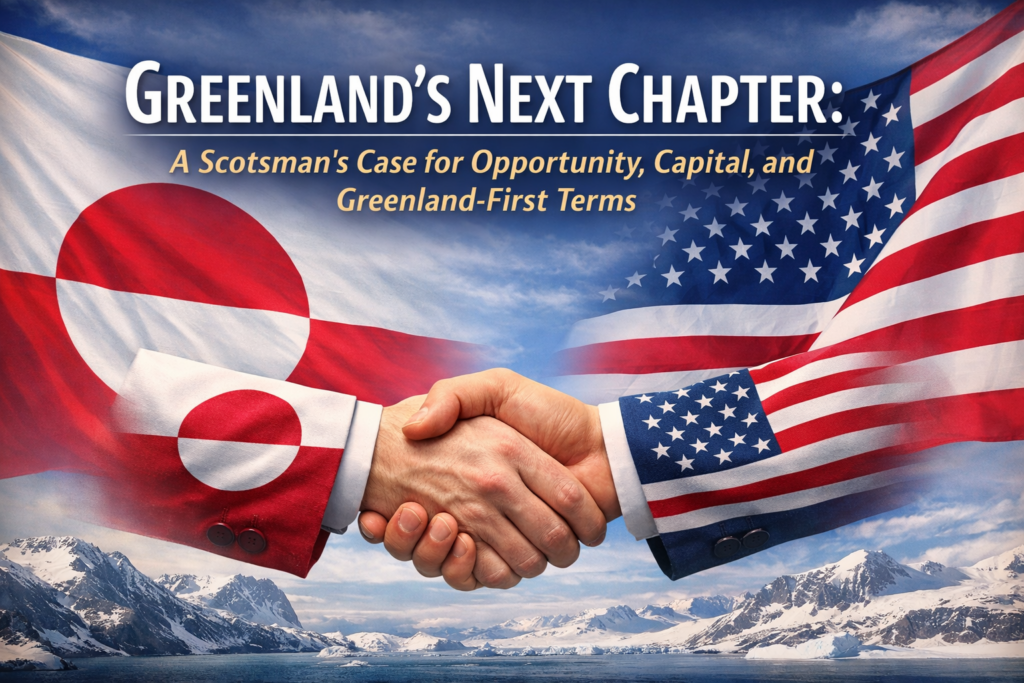
I’m from the Highlands of Scotland. Scotland is a proud place with a deep story, but it also carries a modern reality: a large share of life is organized around government programs and public support structures. That can provide stability, but it can also produce a quieter effect over time: people start making choices primarily to avoid losing benefits, rather than to chase opportunity.
Scotland has had multiple chances to vote for independence. Each time, many voters didn’t choose it not necessarily because they lack pride or ambition, but because the fear of losing the known system becomes a powerful anchor. When your life is tightly coupled to a welfare framework, independence stops looking like freedom and starts looking like risk.
I left Scotland and moved to America to work and build.
What opened up to me was staggering: a huge single market, one currency, one primary language in business, and the ability to travel and operate across 50 states without constantly re negotiating my economic reality. The rule was simple: work hard, be creative, keep going. The upside was real. Over 20 years, I achieved things that would have been extremely difficult to achieve back home. And, yes, I’ve made many many mistakes but I got back up and the reward was waiting if I applied the rule again: work hard, be creative, keep going.
That’s not a knock on Scotland. It’s just a recognition of what different systems incentivize.
And it’s why I look at Greenland and think: don’t drift into a model that accidentally trains an entire generation to manage scarcity and protect benefits. Build a model that rewards initiative and ownership. I get excited when I think about Greenlanders flying down to the United States to live and work.

Greenland’s real choice isn’t America vs Europe
This isn’t about flags. Greenland’s choice is structural:
- Do you want an economic future where the default is dependency management?
- Or do you want an economic future designed for capital formation, skill-building, and ownership?
Europe has strengths: social stability, orderly systems, and strong public institutions. But Europe’s biggest weakness, especially for a frontier economy, is that it often moves at the speed of consensus and risk avoidance.
Greenland is not a typical European region. It’s a frontier economy sitting on strategic geography and high value resources, facing high costs and hard engineering. Frontier economies don’t get built by caution. They get built by focused capital, clear rules, big logistics, and a culture that rewards building.
The United States, for all its flaws, is still the world’s most powerful engine for scaling large projects when the incentives are aligned and the rules are clear.
So the practical question becomes:
Which alignment brings Greenland the fastest path to infrastructure, skills, investment, and world-class partners without compromising Greenland’s control over its own destiny?
What Greenland needs most
Greenland’s constraints are not philosophical. They are physical and logistical:
- Infrastructure: ports, roads, housing, power, communications
- Human capital: training pipelines for operators, trades, engineers, geologists, project managers
- Financing + offtake: long-term buyers and funding structures that can survive commodity cycles
- Regulatory clarity: stable permitting, predictable royalties, credible investment screening
- Local participation: jobs and equity that translate into lasting prosperity for Greenlanders
A direct U.S. relationship could help unlock these but only if Greenland negotiates from strength and designs the framework intentionally. Big projects don’t run on slogans they run on logistics, permitting clarity, skilled labor, capital discipline, and contracts that hold up over time.
The deal Greenland should demand
If Greenland deepens alignment with U.S. capital and strategic industry, it should not be a come take what you want arrangement. It should be a Greenland first contract with enforceable terms.
Here are five non-negotiables Greenland should hard-wire into any major investment framework:
- Local jobs with real training, not token hires
Apprenticeships, operator schools, technical programs, and pathways into management built into project requirements. - Infrastructure that serves communities, not just projects
Ports, roads, power upgrades, and housing must be designed to benefit local life, not only extraction logistics. - Revenue capture that actually lands in Greenland
Royalties and fees are meaningless if they don’t translate into long-term community wealth, services, and reinvestment. - Local equity participation
Greenland should not only collect taxes it should participate in ownership where appropriate, and build institutional capacity over time. - Investment screening with teeth
Greenland has the right to decide what kinds of foreign control threaten security or public order and to intervene when necessary.
This is how you avoid becoming a resource colony. This is how you turn strategic interest into local advantage.
The opportunity Greenland can seize
Done right, Greenland could build a model that looks like this:
- Greenland controls the rules
- U.S. capital accelerates infrastructure
- Greenlanders build skills and ownership
- Projects become platforms not one-off extraction cycles
Greenland doesn’t need to become anyone’s “territory” to benefit from a direct relationship with the U.S. It needs an economic architecture that makes it easier for Greenlanders to build lives of independence, competence, and upward mobility.
That’s the point.
Because the real tragedy isn’t foreign influence it’s a slow drift into a system where people stop believing they can build anything big, and start organizing their lives around not losing what they already have.
For corrections, updates, or inquiries, please contact: sales@greenlandenergy.com