
A COMMUNITY AT BREAKING POINT
Hans Brønlund did not mince words. The chairman of Ittoqqortoormiit’s local council called his 328 neighbors together last week, and when it was over, he put the same message in writing to the companies, ministers, and officials he believed needed to hear it. “We are abandoned as a community,” he told KNR, Greenland’s national broadcaster, which reported on the community meeting and the open letter that followed.
According to KNR’s reporting, the town’s school has carried a mold problem for more than a decade. Some residents receive drinking water in jerry cans rather than through functioning taps. The school, the hospital, the shop, and the warehouse are all affected by health-hazardous mold contamination. The nursing home renovation, scheduled years ago, has not happened. In his open letter, addressed to the companies behind the two resource projects, the Naalakkersuisut, and the municipal mayor, Brønlund described an acute need for investment in the town’s fundamental infrastructure.
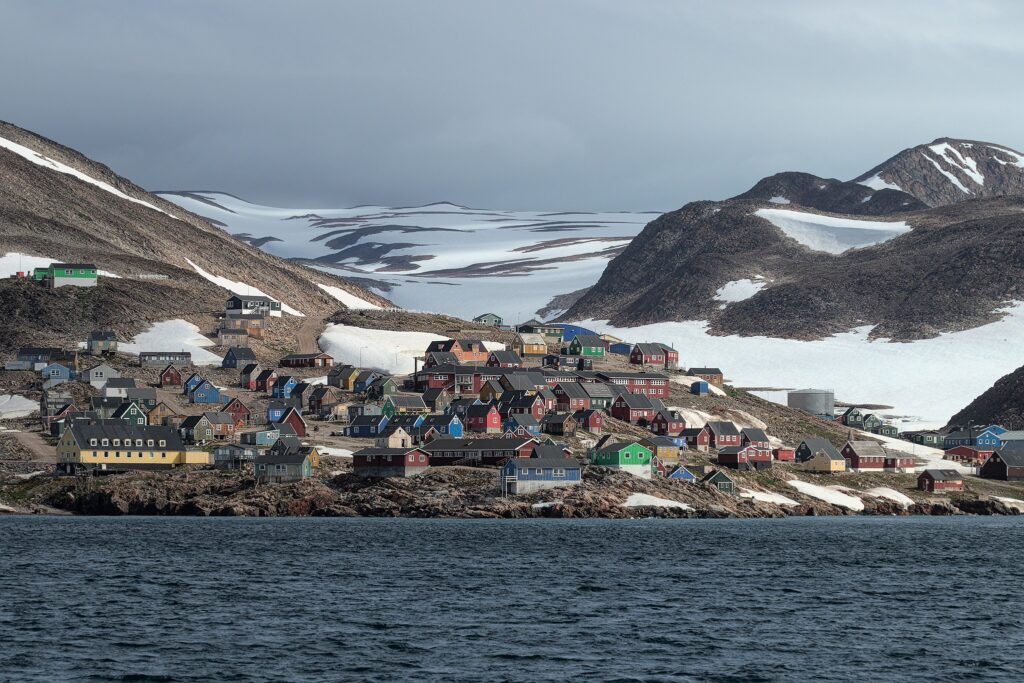
Erling Madsen, a former mayor and municipal council member, told KNR that the mayor visits Ittoqqortoormiit extremely rarely. “I have never met her, and it is her second term,” he said. Kommuneqarfik Sermersooq later told KNR that the mayor most recently visited Ittoqqortoormiit in September 2025.
Kommuneqarfik Sermersooq told KNR that health care, supply, transport, and some infrastructure issues fall under the Government of Greenland’s responsibility. The municipality acknowledged that the school is its responsibility and said funding for renovation was included in the 2026 budget settlement, with the first phase now underway.
A deep-water harbor that would cut a multi-day container unload to half a day remains unbuilt, Madsen told KNR. Without it, the supply ship can only be served by smaller vessels handling two containers at a time, a process that takes three to four days and drives up freight costs for an already isolated community. Royal Arctic Line raises its prices year after year. Fresh produce is a chronic problem. Patients awaiting discharge have waited up to two months for transport. Mail, including bills and official correspondence, can take months to arrive.
Families traveling between East Greenland settlements must route through Iceland to stay within their own country’s borders. Madsen described to KNR how his daughter’s visit from Tasiilaq last October, Tasiilaq to Nuuk, Nuuk to Iceland, Iceland to Nerlerit Inaat, Nerlerit Inaat to Ittoqqortoormiit, cost close to 50,000 kroner, over 60,000 including hotel stays, and was delayed repeatedly by weather.
THE PARLIAMENTARIAN WHO WAS ALREADY ASKING
Mette Arqe-Hammeken, a member of Inatsisartut representing the Naleraq party, which advocates for the rights and interests of Greenland’s remote settlements and outer districts, had already placed formal questions before the Parliament of Greenland ahead of last week’s community meeting.
In a formal §37 question submitted to Inatsisartut in December 2025, Arqe-Hammeken asked the Government of Greenland to clarify the current status of oil exploration in Jameson Land and to state when exploration activities are expected to begin. She also asked how local residents of Ittoqqortoormiit would benefit from those activities, specifically what employment opportunities would be made available and whether training programs would be offered to ensure local workers could participate meaningfully.
Her questions extended to infrastructure. She asked the Naalakkersuisut whether the planned new airport for Ittoqqortoormiit was considered to be of significant benefit to oil exploration, and if so, how the required runway length should be specified to serve both cargo and exploration needs. The question was precise: if Jameson Land exploration activity will require air, cargo, and service infrastructure near Ittoqqortoormiit, should the infrastructure being built for the community be designed with that activity in mind, and if so, who bears the cost of that specification?
When the Inatsisartut formally debated the issue on Tuesday, Arqe-Hammeken told the chamber that her town had been “invisible on the map of Greenland” for too long, and called on the Naalakkersuisut to act regardless of cost, according to KNR’s coverage of the session. KNR also reported that the new minister responsible for housing, infrastructure, outer districts, and emergency preparedness, Iddimanngiiu Jensen Bianco, announced on Thursday, April 23, that an agreement had been reached with Norlandair to increase flights to Nerlerit Inaat and onward to Ittoqqortoormiit, including more cargo capacity.
GREENLAND ENERGY COMPANY AND JAMESON LAND
The community meeting Brønlund convened was called to discuss two resource projects connected to underground value near the town — one oil project and one mining project. KNR linked the oil side of that discussion to its earlier reporting on Greenland Energy Company’s Jameson Land plans.
Greenland Energy Company, which listed on Nasdaq on March 26 under the ticker GLND, holds exploration and production licenses on Jameson Land acquired from the prior license holder White Flame. The company’s CEO Robert B. Price was described as targeting 13 billion barrels of oil in the area, a figure Price had discussed publicly in a NewsNation appearance cited by GLND’s partner 80 Mile PLC.
Jørgen Hammeken-Holm, Permanent Secretary for Minerals and Business at the Government of Greenland, said GLND licenses are valid and predate Greenland’s 2021 oil exploration ban, meaning the prohibition does not apply to them.
THE CHOICE IN FRONT OF THEM
Ittoqqortoormiit is not within GLND’s license area. But it is the nearest permanent community to Jameson Land, and it is the community whose infrastructure, whose harbor, and whose people would bear the indirect weight of any significant resource activity in the region. The town’s local council has made that connection explicit. Brønlund’s open letter was addressed not only to government but directly to the resource companies. Arqe-Hammeken made the same connection months earlier in formal parliamentary questions.
What government has not yet delivered, capital could still choose to support. The precedent exists across the Arctic: resource companies that invest in community infrastructure before operations begin build trust that outlasts any single project. Those that do not build the opposite.
For Greenland Energy Company, the calculus is not complicated. A company launching on a major exchange, seeking investor confidence, operating under a pre-ban license in a jurisdiction where public sentiment toward resource extraction is genuinely contested, has an opportunity to define its relationship with the nearest community before major field activity begins.
A deep-water harbor. A school free of mold. Running water in every home. Employment pathways and training for local workers. These are not extravagant demands. They are the baseline conditions that most of the developed world takes for granted, and the specific asks that Ittoqqortoormiit’s elected representative put on the parliamentary record before the community ever called a public meeting.
The children of Ittoqqortoormiit have been breathing mold for ten years. That is the fact at the center of this story. Whether a newly listed American energy company chooses to see that as someone else’s problem, or as an opening to demonstrate what responsible Arctic resource development actually looks like, will say something lasting about what kind of operator Greenland Energy Company intends to be.
Sources: KNR (Kalaallit Nunaata Radioa), April 26, 2026, reporter Isak Hüllert; KNR, April 13, 2026, reporter Markus Valentin; Inatsisartut §37 question no. 214, submitted by Mette Arqe-Hammeken, received December 5, 2025 and sent to Naalakkersuisut December 8, 2025. Hammeken-Holm and Varming quotes via KNR. Inatsisartut session coverage via KNR. Open letter by Hans Brønlund as reported by KNR.
GreenlandEnergy.com provides independent analysis of Greenland’s energy landscape, critical minerals development, and Arctic geopolitics. For corrections or feedback: press@greenlandenergy.com
READ NEXT: Qaqortoq Airport Is More Than a Travel Upgrade

