
Greenland Arctic Development Corp has bought a Caracol Heron 400 industrial robotic 3D-printing system for a planned locally operated manufacturing venture in Greenland.
Caracol, the Milan-founded advanced-manufacturing company with its North American base near Austin, Texas, published the announcement on October 14. The system will first be installed, tested and commissioned in Chicago before being transported to Greenland.
GADC says it plans to recruit a Greenlandic entrepreneur who would receive technical training and the opportunity to develop and operate a joint venture using the system.
Manufacturing in Greenland
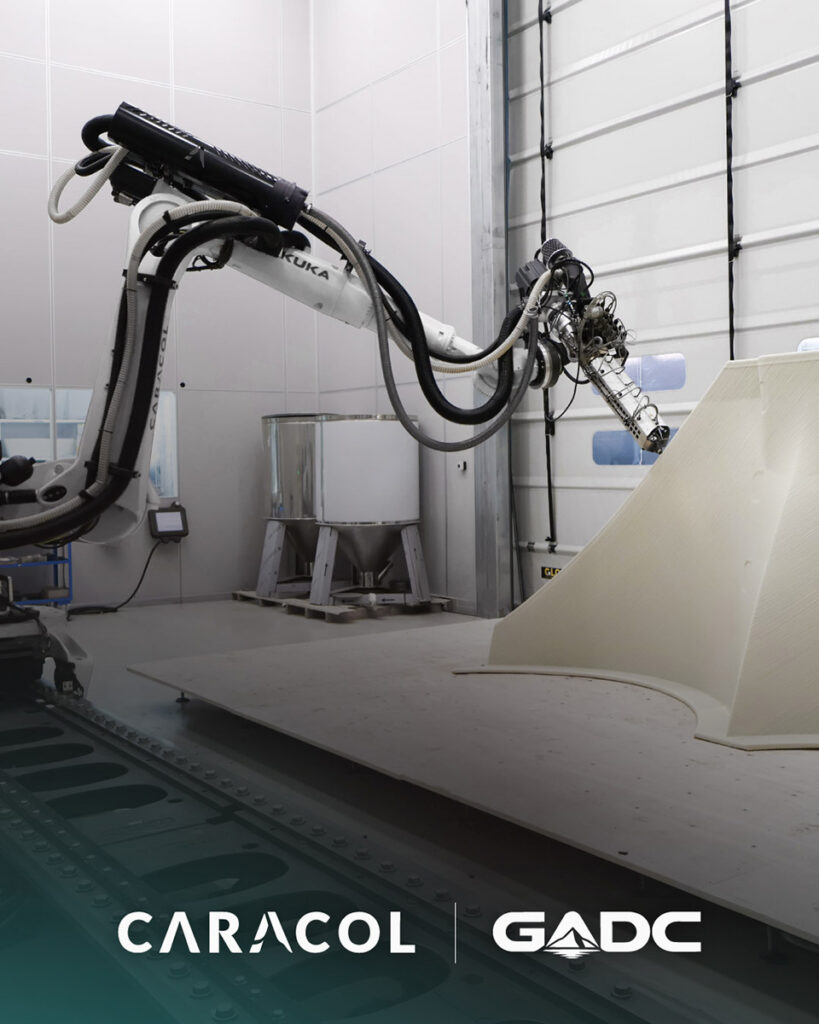
The Heron 400 is designed to produce large polymer and composite components from digital designs. Its six-plus-axis robotic arm moves along a configurable rail, allowing customized, low-volume products to be made without the molds and dedicated tooling conventional manufacturing often requires.
For Greenland, the significance is bringing selected production closer to where it is needed. GADC sees potential applications ranging from furniture and marine components to parts for boats, ATVs and snowmobiles, construction elements, industrial components and products designed for Arctic conditions.
For international companies supporting equipment in Greenland, the system could also become a useful part of aftermarket support—producing selected custom components, molds and fixtures closer to customers rather than ordering every low-volume item from abroad.
Francesco Pantaleone, Caracol’s Head of Sales, Americas, said robotic large-format printing allows a single flexible production cell to turn digital designs into parts where they are needed, in the quantities needed. “Greenland is one of the most demanding places to prove that model, and we are proud to support GADC and its local partners in building a business around it,” he said.
The system is suited to thermoplastics and fiber-reinforced composites, so its role will be in selected components rather than every part. But for suitable products, digital files could become a form of inventory: ready to be made locally when the need arises.
The larger prize is skilled work, new technical capability and a Greenlandic company built around making things in Greenland.
Local ownership is the central promise
GADC Chairman Larry G. Swets Jr. said the project is meant to create more than a new piece of imported equipment.
“Our goal is not simply to bring a machine to Greenland — it is to help build a locally led business around it,” Swets said.
GADC says the proposed facility is intended to support Greenland’s natural-resource, infrastructure and tourism sectors, while also serving the everyday needs of Greenlandic businesses, communities and consumers.
Before the system is transported to Greenland, GADC plans to use the Chicago commissioning program to evaluate materials, production methods and possible Arctic applications. The work is also intended to help establish the training, operating and commercial framework for the proposed joint venture.
Disclosure: GADC is a paying advertiser on GreenlandEnergy.com. The company had no editorial control over this article.
GreenlandEnergy.com provides independent analysis of Greenland’s energy landscape, critical minerals development, and Arctic geopolitics. For corrections or feedback: press@greenlandenergy.com
