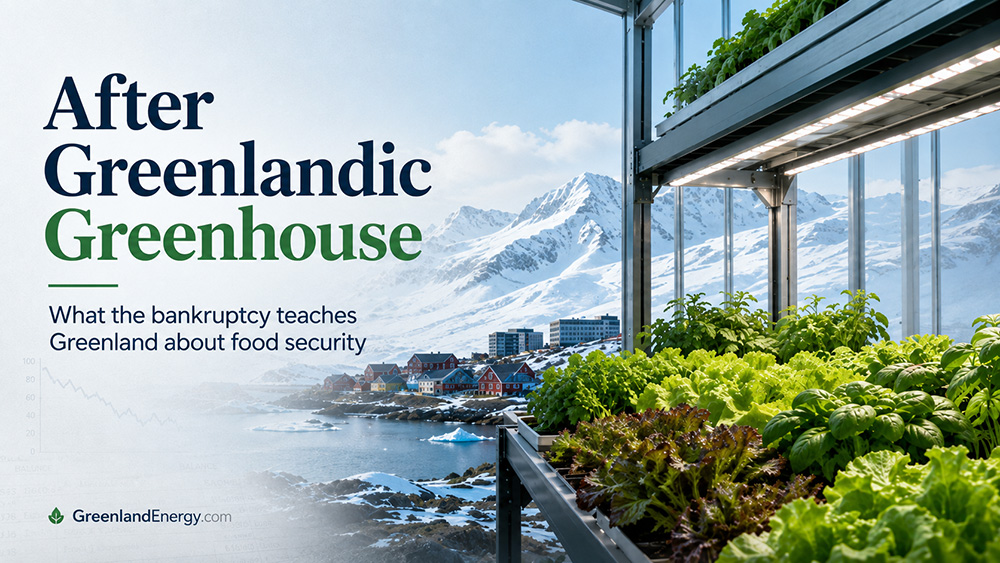
Greenlandic Greenhouse once showed what local food production in Greenland could look like.
From Nuuk, the company grew pesticide free salad and herbs indoors, using vertical farming, LED light, recycled water, local hydropower and surplus heat. The idea was simple but important: fresh food grown in Greenland, for Greenland, in a country where imported vegetables travel long distances and often arrive expensive and spoiled.
In 2021, the project was nominated for the Nordic Council Environment Prize. Nordic Council’s nomination described Greenlandic Greenhouse as an environmentally friendly food producer powered by local hydroelectricity and recycling more than 90 percent of its water. The same nomination noted that Greenland imports about 3,600 tons of vegetables annually for a population of roughly 56,000 people.
Greenlandic Greenhouse was treated as a promising food security example, but it quietly collapsed without much public attention. Public company records list Greenlandic Greenhouse ApS, CVR 40018042, as dissolved after bankruptcy.
The company collapsed, but the lesson should not disappear with it. It gives Greenland a reason to study the attempt carefully before the next project begins: what worked, what broke down, what support was missing, and what kind of model could survive in Greenland’s actual conditions.
Was this simply the ordinary failure of a small food startup operating in one of the world’s most difficult markets, or did it expose a deeper weakness in how Greenlandic private companies are protected when larger partners, suppliers, lenders or contract relationships change course?
Food Security Has to Fit Greenland’s Real Conditions
Imported food often wins on price because it benefits from scale, established suppliers, freight relationships and familiar procurement habits. A local greenhouse has to compete against that system while carrying much higher operating costs.
That creates a hard commercial question. Vertical farming in Greenland may not yet be viable as a standalone private business, especially if it depends only on premium greens sold into a small consumer market.
Greenland’s Self Sufficiency Strategy 2025 to 2030 takes a practical view of the same problem. Geography, climate, population size and logistics all set limits. The goal is not total food independence. It is resilience: more local production where it can work, stronger skills, more innovation and a food system better able to withstand disruption.
The Department of Education, Culture, Sports and Church told GreenlandEnergy.com on June 25 that self sufficiency, in a Greenlandic food and education context, means strengthening the country’s ability to produce more of its own food and reduce dependence on imports where practical.
There is also a research case. Greenland is one of the most challenging food environments in the world. Learning how to grow fresh food reliably in Arctic conditions has value beyond one company or one crop. Even commercially difficult experiments can produce knowledge for future food systems, remote infrastructure and cold climate agriculture.
Inuili Is Human Infrastructure
The department made another important point: Inuili, Food College Greenland in Narsaq, is not just a school for cooks and hospitality workers. It is part of Greenland’s national human infrastructure.
The department said trained professionals in food production, hospitality, agriculture, fish and food processing contribute directly to economic development, employment, tourism, public health and food security.
Greenland’s future infrastructure includes the people who can produce, process, preserve, prepare and safely serve food. That includes cooks, bakers, butchers, fish processing workers, sheep farmers, hospitality staff and, potentially, people trained in greenhouse cultivation, hydroponics, food technology and controlled environment growing.
The department also acknowledged the biggest barriers to using more Greenlandic ingredients in public kitchens, restaurants, local businesses and tourism.
Cost is one of the largest. Greenlandic ingredients are often more expensive than imported products because of limited production volumes, transportation costs and seasonal availability. Other barriers include availability, logistics, processing capacity and stable supply.
America Has Already Paid for Some of the Lessons
Greenland does not have to learn everything the hard way.
The United States has already spent enormous sums testing the promise and limits of vertical farming. Some of the technology worked. Many of the business models did not.
Bowery Farming, once one of the best known American vertical farming companies, shut down in 2024 after raising more than $700 million. Agriculture Dive reported that Bowery’s closure came as indoor farms faced cost challenges, weak investor funding and wavering demand for premium produce.
AppHarvest, a high profile controlled environment agriculture company in Kentucky, filed for bankruptcy in 2023 after lower than expected yields and elevated operating costs weighed on the business.
AeroFarms filed for Chapter 11 protection in 2023 before restructuring. Plenty filed for Chapter 11 in 2025 and later emerged with a narrower focus on strawberries.
Vertical farming is unforgiving.
It punishes oversized facilities, weak crop selection, high operating costs, cheap capital assumptions, labor problems, technical complexity and the belief that consumers will always pay a premium for produce because the story sounds good.
American growers, engineers, suppliers and controlled environment agriculture companies have already tested equipment, lighting systems, crop choices, labor models and facility designs at a scale Greenland does not need to repeat. The useful opportunity is collaboration without the hype: direct trade, smaller pilot systems, technical exchange, education partnerships and practical exposure to what has already worked and failed in the United States.
Trade shows in the United States could be especially valuable. Greenlandic food producers, students, municipal leaders and policymakers could meet equipment suppliers, greenhouse operators, seed companies, automation specialists and researchers in one place. That kind of contact would help Greenland compare real systems before committing public money or private capital to the next project.
Greenland Is Different, But Not Exempt
In the United States, many vertical farms tried to compete against an already efficient produce system serving dense consumer markets. A premium bag of indoor lettuce has to compete against cheaper field grown produce already moving through mature supply chains.
Greenland’s problem is different.
Here, the question is whether local production can reduce spoilage, improve freshness, strengthen food safety, support public supply, build local skills and reduce exposure to imported supply disruption.
A future Greenland greenhouse strategy may depend less on ordinary consumers alone and more on contracts with hospitals, elder care homes, schools, hotels, restaurants, supermarkets, public kitchens, construction camps, mining camps, airports and other operations where reliable fresh food has direct value.
A New Attempt in Narsarsuaq
Agroprojekt Ilua, led by Julian H. Sonne from Narsarsuaq, is developing and testing systems for local Arctic agriculture in South Greenland. The project describes its work as field based, with measurements, crop trials, engineering preparation and open documentation underway. Ilua says its approach connects greenhouse design, microclimate, energy use and crop selection as one system.
In an April 6, 2026 post on X, Sonne described Agroprojekt Ilua as a personal and practical response to Greenland’s dependence on imported fresh produce, which he called expensive, fragile and unreliable. He said the initial plan is to prototype a 100 square meter Arctic greenhouse in Narsarsuaq, with potential to scale to 300 square meters, combined with open field growing and landscape design to create better microclimate conditions.
He also made clear that the project remains early stage. The models are still being developed and tested in simulation before work moves to the actual site. Sonne said he was relocating to Narsarsuaq to begin that process and that “everything I learn will be published open source.”
Ilua’s website says a six hectare land application is under review with Kommune Kujalleq, specialist engineering and supplier dialogue are underway, and Phase 1 remains in development. The site also says there is not yet a salary in the project, and that public support is helping cover field work, crop trials, engineering preparation, open documentation and the founder’s time on site.
That makes Ilua relevant to the Greenlandic Greenhouse lesson. It is another attempt to understand what can grow in Greenland, what can sell, what can pay for itself, and what kind of system can survive local conditions.
GreenlandEnergy.com has reached out to Julian Hrasko Sonne for comment on Agroprojekt Ilua, the current status of the project, and the lessons future Greenland greenhouse projects can take from earlier attempts.
What Comes After Greenlandic Greenhouse
Greenlandic Greenhouse deserves a serious review. The company moved local indoor growing from idea to shelf, which is a real achievement in Greenland’s conditions.
The review should look beyond simple business failure. What made the economics difficult? Was the buyer base large enough? Would a smaller modular model have had a better chance? Could demand from a hospital, school, elder care home, hotel group, construction camp, mining camp or public institution have given the project a stronger foundation?
There is also a larger question for Greenlandic private enterprise. When small local companies depend on larger partners, suppliers, contracts or financing relationships, what protections exist if those relationships change course? A food security project can fail because the market is too small or the costs are too high. It can also fail because the business model leaves local founders carrying risks they cannot absorb.
GreenlandEnergy.com is currently in contact with several American and European vertical farming and controlled environment agriculture companies and will continue reporting on this subject as the commercial and policy picture develops.
GreenlandEnergy.com provides independent analysis of Greenland’s energy landscape, critical minerals development, and Arctic geopolitics. For corrections or feedback: press@greenlandenergy.com
READ NEXT: McIllree Takes Charge of GLND’s Greenland Role After Messaging Confusion